Vetcalculators
- 3.9
- Rating
- 10.00K
- Installs
- Free
- Price

 Analysis by App-foxy
Veterinary calculations are one of those tasks that look simple until a patient is waiting, the prescription needs checking, and several variables have to be handled at once. I found Vetcalculators most useful in exactly that space: it brings a collection of veterinary calculation tools together in a free medical app from VetCalculators, rather than making me search through separate references or build every calculation from scratch.
My first impression was practical rather than polished. This is not an app designed to entertain or teach veterinary medicine from the beginning. It is a working calculator for people who already understand the clinical context and need help turning weight, concentration, dose, fluid rate, or infusion information into a usable result. That distinction matters. Vetcalculators supports clinical arithmetic; it does not replace clinical judgement.
The app covers emergency drugs, anesthetics, constant-rate infusions, fluids, and other veterinary calculations. I would place it firmly in the medical utility category, with a target audience that includes veterinary professionals, students, and people in supervised training. It is available free of charge, with optional in-app purchases priced at $3.99 per item. Its Everyone age rating makes it broadly accessible, although the subject matter itself is professional and should be treated responsibly.
You May Also Like

 AccuWeather: Weather Radar
AccuWeather Review: A Quick, Clear Forecast for Everyday Decisions
For everyday plans, the best forecast is the one you can understand quickly. AccuWeather makes rain timing, radar, and local conditions easy to act on, with a few trade-offs.

 Hill Climb Racing
Why Hill Climb Racing Still Turns Crashes Into One More Run
A tiny car, a bumpy hill and one more upgrade: Hill Climb Racing keeps resurfacing because its simple chaos makes every near-miss feel personal.

 AliExpress - Shopping App
AliExpress Makes Global Shopping Feel Personal, but Shoppers Bear the Risk
AliExpress turns a global marketplace into a pocket-sized discovery engine. Its reach is useful, its shopping loop compelling, and its trade-offs easy to miss.

 Lords Mobile: Kingdom Wars
Lords Mobile Is a Kingdom-Building Routine, Not a Quick Match
A case-by-case verdict on the building, battles, device demands, and social commitments that make Lords Mobile rewarding for some players and exhausting for others.

 PDF Scanner app - TapScanner
TapScanner Makes Paperwork Easier to Capture, Check, and Share
TapScanner makes scanning with a phone feel less like a rescue operation and more like a dependable step in getting work done. Its capture tools are useful, though not flawless.

 Block Blast!
 Shows How Much a Puzzle Game Can Leave Out
A quiet grid game shows why puzzle players increasingly value instant clarity, repeatable skill and low-pressure play—and where the genre still needs to catch up.
More From Our News Desk
View All News


How I use the app during a normal calculation
The most sensible workflow begins before opening a calculator. I first identify what I am actually trying to calculate: a dose volume, an infusion rate, a fluid requirement, or a related anesthesia value. That small pause prevents a common mistake with multi-purpose tools—entering correct numbers into the wrong calculator.
Once I select the relevant area, I treat the screen as a structured worksheet. I gather the patient’s current weight, confirm the units I am using, check the drug concentration or fluid specification, and then enter the values in a deliberate order. The app can make the arithmetic faster, but it cannot tell me whether the chosen dose is appropriate for the patient in front of me.
This is especially important in an emergency setting. Imagine a patient arriving for urgent stabilization while someone is preparing equipment and another person is checking the medical record. A calculator can reduce the time spent multiplying and converting, but the result still needs a second check against the prescription, the vial label, and the intended route. I would use Vetcalculators as one part of that handoff, not as the only safety barrier.
A useful habit is to read the result aloud or write it into the treatment record immediately after checking it. That turns the app from a quick answer machine into part of a repeatable process. I also prefer entering the patient’s weight from the current record rather than relying on memory. A calculation can be perfectly executed and still be wrong if the starting weight is outdated.
Why the broad calculator collection is useful
The main advantage is concentration. Emergency drug calculations, anesthetic work, CRI calculations, and fluid-related tasks often appear in the same clinical session, so having them grouped in one app is more convenient than switching between unrelated tools. It also reduces the temptation to improvise a spreadsheet or search the web while under pressure.
That convenience is strongest for people who already repeat these tasks. A student learning the difference between dose, dose rate, concentration, and final volume may still need a textbook, instructor, or clinical protocol beside the app. An experienced user, by contrast, can move through familiar inputs quickly because the underlying concepts are already understood.
I would not describe it as a complete veterinary reference library. Its value is narrower and more practical: it helps with calculations that otherwise require mental arithmetic, written formulas, or a general-purpose calculator. That focused role is a strength when time matters, but it also explains why beginners should not mistake a numerical result for a treatment recommendation.
Settings and preparation that deserve attention
Before depending on any calculator, I would spend time checking how it handles units and input fields. The exact details of a result can change when weight is entered in the wrong unit or a concentration is confused with a total amount. Even when the interface appears straightforward, I make a deliberate point of confirming every label rather than tapping through from habit.
I also check whether the selected calculation matches the patient species and clinical situation before entering the numbers. Veterinary work is not interchangeable across every patient, and an app cannot compensate for choosing an inappropriate formula. The safest setting is therefore not a hidden toggle; it is a disciplined setup routine.
Another practical check is the app version. Vetcalculators is currently at version 3.1.13, and it was released on October 22, 2017. That history suggests a tool that has been available for a long time, but I would still avoid assuming that longevity makes every calculation suitable for every current protocol. I would compare important outputs with the clinic’s approved references, particularly when a patient is unstable or the calculation involves a high-risk medication.
Because the app is free to install but includes optional purchases, I would also identify which parts of the workflow are available without payment before building a routine around them. That is a small but worthwhile step. A calculator that is useful during practice may become inconvenient if the specific module needed in a busy situation is not part of the free experience.
Repeatable habits that make the app faster
The quickest users are not necessarily the people who type fastest. They are the people who prepare the inputs before opening the calculator. I keep the patient weight, medication concentration, prescribed dose, and intended time period together. That prevents repeated trips between the app, the vial, and the record.
For a CRI calculation, I separate the problem into three checks: what the patient should receive per unit of time, what concentration is available, and what final delivery rate is practical. The app can perform the arithmetic, but thinking through those three layers first makes it easier to spot a result that looks implausible.
For fluid calculations, I similarly distinguish the planned volume from the delivery rate. A total volume over a period of time is not the same thing as a pump setting, and a calculator should not be asked to resolve a misunderstanding between those two concepts. Entering the values only after defining the desired output makes the workflow clearer.
For emergency drugs and anesthetics, I make the vial concentration a visible part of the check. Concentrations can vary between products, and relying on a remembered value is exactly the kind of shortcut that creates avoidable risk. Vetcalculators is most helpful when I use it to process verified inputs, not when I use it to guess them.
A second experienced-user habit is to repeat a critical calculation independently. That can mean using a written formula, a clinic-approved reference, or another calculator. I would not repeat every low-risk arithmetic task this way, but I would do it when the result affects a narrow safety margin, a very small volume, or a patient whose condition is changing quickly.
Where it fits better than ordinary alternatives
The usual alternative is a basic calculator app. That option is flexible, familiar, and often already installed, but it makes the user remember the formula and manage unit conversions manually. Vetcalculators is better when the calculation type is already represented and the user wants a more guided path through the inputs.
A spreadsheet is another common alternative. Spreadsheets are excellent for customized protocols, audit trails, repeated patient records, and calculations a clinic has designed for itself. They can also be easier to review with colleagues. Vetcalculators is more convenient for a quick standalone calculation, while a spreadsheet is often better for building a controlled departmental workflow.
Printed reference cards and textbooks still have an important advantage: they provide context, cautions, and explanations around the formula. The app is faster for arithmetic, but a reference is better when I need to understand why a calculation is structured a certain way or when a protocol needs to be checked in full.
That makes the app complementary rather than dominant. I would choose it over a blank calculator for routine veterinary arithmetic, but I would choose a trusted clinical reference over it when the question is about whether a dose, route, dilution, or protocol is appropriate.
Limitations I would take seriously
The biggest limitation is the risk of false confidence. A neatly displayed number can feel authoritative even when the wrong patient weight, concentration, unit, or calculator was selected. The cleaner the result looks, the more important it becomes to preserve the human verification step.
The app is also less suitable for someone who wants extensive explanations. Its purpose is calculation, so a novice may find the experience too abrupt without outside teaching. If you are still learning the underlying pharmacology or fluid therapy, I would use the app alongside supervision rather than as a self-contained course.
Another limitation is that a general calculator collection may not match every clinic’s preferred protocol. Veterinary practices often have local dilution standards, monitoring requirements, and documentation habits. Even a correct mathematical result may need adjustment to fit the equipment, formulation, or policy used in a particular workplace.
I would also be cautious about using it as the sole tool when connectivity, device access, or attention is unreliable. A phone can be misplaced, unavailable, or difficult to read during a hectic procedure. A printed backup or established manual method remains sensible for critical work.
Who should use it—and who should skip it
Vet students can benefit from it when an instructor has already explained the relevant formulas and wants them to practise applying the numbers. Veterinary nurses, technicians, and clinicians may find it more valuable in recurring emergency, anesthesia, infusion, and fluid workflows. Its strongest audience is anyone who performs these calculations often enough to appreciate having them organized in one place.
I would skip it as a primary tool if I were looking for symptom guidance, diagnosis, comprehensive drug information, or patient-specific treatment advice. It is also not the right choice for someone who wants an educational app that explains veterinary medicine from first principles. In those cases, a structured course, professional reference, or supervised clinical resource would be a better fit.
For pet owners, the situation is even clearer. The Everyone rating describes accessibility, not clinical suitability. A pet owner might use the app out of curiosity, but should not use a veterinary calculator to decide medication amounts or fluid therapy at home. Those decisions belong with a veterinarian who knows the animal’s diagnosis and condition.
My final assessment after building a routine around it
Vetcalculators is a focused tool with a clear practical purpose. I like it because it brings several veterinary calculation areas into one place and can remove repetitive arithmetic from emergency, anesthesia, CRI, and fluid workflows. The free entry point makes it easy to try, while the optional $3.99 purchases mean I would check the available modules before depending on a particular one.
The app has earned a 3.9 average from over 275 ratings, with more than 44 written reviews, and its install base has passed 10K. Those figures suggest a modest but established audience rather than a universal standard. I would interpret that as a reason to test it against my own clinic’s procedures, not as proof that it should replace them.
My recommendation is straightforward: use it as a calculation assistant, create a consistent input-and-verification habit, and keep a trusted clinical reference close by. The best results come from experienced users who know what they are calculating and use the app to speed up the arithmetic. If that describes you, Vetcalculators can be a useful addition to an Android device running at least version 6.0 of the operating system. If you need diagnosis, treatment education, or independent clinical decisions, look elsewhere.
FAQs for Vetcalculators
01What is Vetcalculators and who is it designed for?
Vetcalculators is a veterinary calculation app intended to assist with common clinical math tasks, such as drug dosages, fluid therapy, nutrition, and other patient-related calculations. It is mainly useful for veterinarians, veterinary nurses, students, and clinic staff. The app should be treated as a support tool rather than a replacement for professional judgment, current references, or a veterinarian’s responsibility to verify every result.
02What types of calculations can I perform with Vetcalculators?
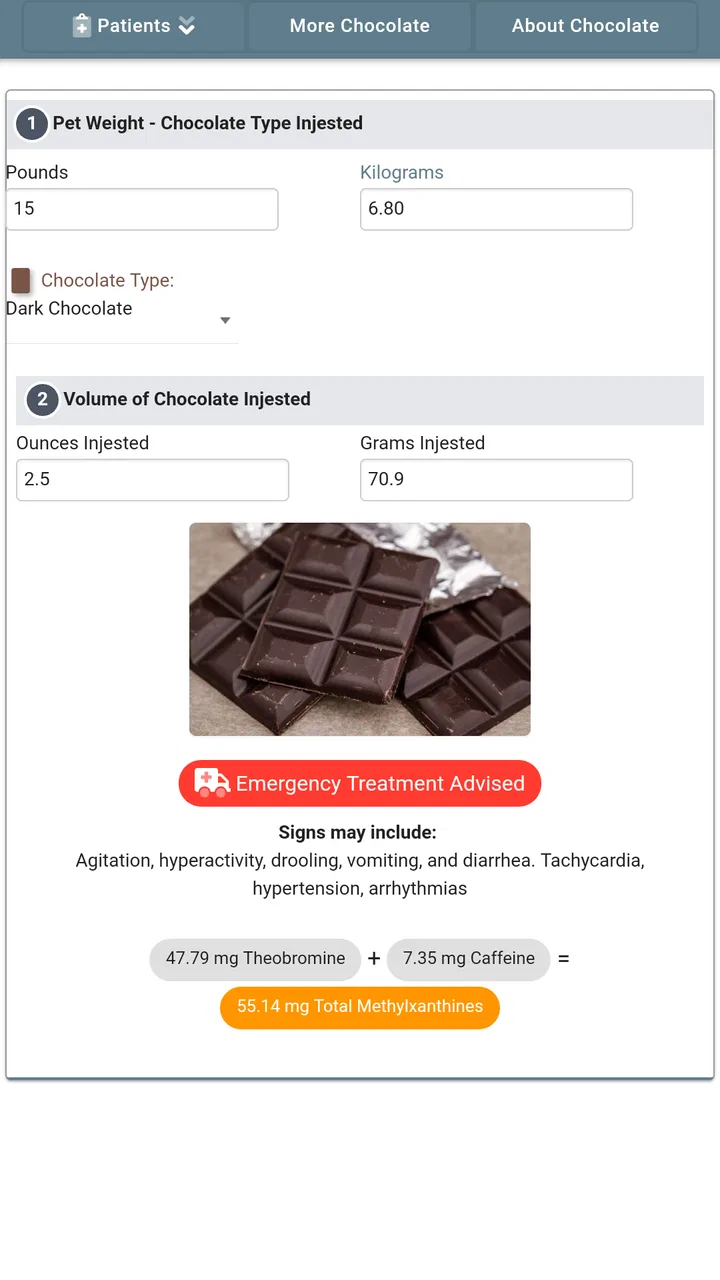
The app brings together a range of calculators commonly used in veterinary practice. Depending on the available version and platform, these may include medication dosing, fluid rates, constant-rate infusions, body-weight conversions, nutrition, anesthesia, and emergency-related calculations. Before downloading, users should review the app’s current calculator list because features can change between updates, and not every calculator will apply to every species or clinical situation.
03Can Vetcalculators be used for every animal species and medical case?
Vetcalculators can be helpful across several veterinary scenarios, but its calculators should not automatically be assumed to apply to every species, breed, age, or condition. Drug concentrations, recommended doses, fluid requirements, and clinical formulas can vary significantly between dogs, cats, horses, exotic pets, and other animals. Always confirm the selected species, units, patient weight, and clinical assumptions before using a result.
04Is Vetcalculators accurate enough to use in a veterinary clinic?
The app can make routine calculations faster and reduce manual arithmetic, but no calculator should be used without professional verification. Accuracy depends on entering the correct weight, concentration, dose, units, and requested volume. A misplaced decimal or incorrect unit can produce a dangerous result. Veterinary professionals should compare outputs with trusted formularies, treatment protocols, product labels, and the patient’s individual needs.
05Does Vetcalculators require an internet connection, and is it free to download?
The availability of offline use, advertising, premium tools, and in-app purchases may depend on the version offered for Android or iOS. Many calculation apps allow core functions to work without a constant connection, but users should confirm this in the store description before relying on it during emergencies or in areas with poor reception. Check the current listing for pricing, supported devices, permissions, and subscription details.
Pros
- Covers many veterinary calculations in one convenient app.
- Helps reduce manual math errors during clinical work.
- Useful for students
- nurses
- and practicing veterinary professionals.
- Calculators are generally quick to access and simple to operate.
- Supports faster dose
- fluid
- and nutrition planning in daily practice.
Cons
- Results depend entirely on entering accurate patient information.
- Not a substitute for professional judgment or treatment guidelines.
- Some calculations may require knowledge of veterinary terminology.
- The interface may feel basic compared with modern medical apps.
- Availability of certain features may vary by device or app version.

Vetcalculators
Gallery